


Experimental Seeing: Russell Lee’s Pedagogical Legacy

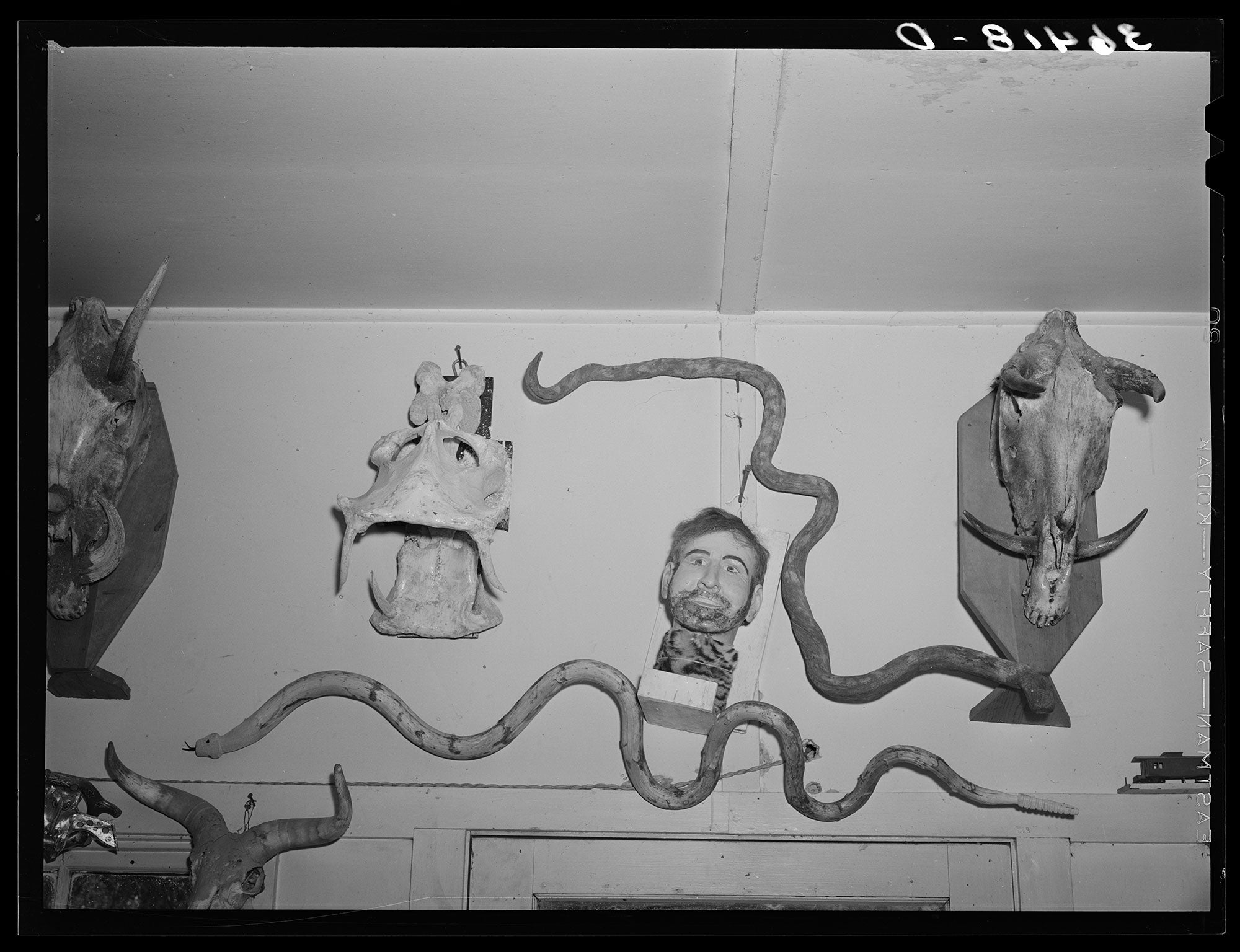
Russell Lee's photograph of Homer Tate's studio showing various oddities and gaffs on the wall

Russell Lee, Work of Homer Tate. Safford, Arizona, May 1940. Black and white negative. Courtesy of the Library of Congress, Prints and Photographs Division, Farm Security Administration / Office of War Information.

Event Status
Scheduled

Opening Reception:
Fri. Sep. 4, 5–8 p.m.

Following his 1965 retrospective exhibition at the University of Texas Art Museum (now the Blanton Museum of Art), photographer Russell Lee was tasked with a radical mandate: to build the first photography program in the College of Fine Arts. Eschewing technical language, Lee described his innovative curriculum not as a series of photography classes, but as “experimental courses in seeing.”

This exhibition marks the 60th anniversary of the Department of Art and Art History’s photography program, surveying work by twenty-five exceptional MFA graduates who have benefited from Lee’s pedagogical legacy. While their practices remain rooted in photographic methods and materials, the included artists blur the boundaries of the medium, forming expansive visual languages that encompass print, sculpture, installation, video, and more. Spanning nine US states and four countries, the artists respond to Lee’s proposition by treating photography not as a destination, but a starting point through which to see the world.

Who was Russell Lee? 

Initially trained as a painter, Lee (b. 1903, Ottawa, Illinois – d. 1986, Austin, Texas) began taking photographs at age 32. He is best known for a corpus of over 20,000 images he made between 1936 and 1942 under the auspices of the Farm Security Administration / Office of War Information photography project, a New Deal-era government initiative to document living conditions for migrant laborers and rural communities during the Great Depression. Under the management of economist and photographer Roy Stryker, Lee and fellow travelers such as Dorothea Lange, Walker Evans, Ben Shahn, and Gordon Parks fanned out across the country to create what would become the most extensive, studied, and debated records of American life in the 1930s and 40s.

A Chance Meeting 

In 1940, Lee made repeat trips to the small, unincorporated community of Pie Town, New Mexico, where he produced what would become his most famous body of work. Along the way, he happened upon the workshop of Homer Tate, the manager of a motel and service station in Safford, Arizona. Tate (b. 1884, Poetry, Texas – d. 1975, Phoenix, Arizona) was also a maker of “gaffs,” a carnival slang term for sideshow oddities and trick objects. Over decades Tate, who some called the “King of Gaffs,” made hundreds of constructions like those pictured here: from papier-mâché, wood, stone, clay, hair, and animal bones, horns, and claws. Later, Tate opened a curio shop and became an established name in the carnival and sideshow business, even publishing a catalog of his wares. Among his best-known surviving works is an ersatz mummy known as “The Thing,” the centerpiece of a roadside attraction off Interstate 10 between El Paso and Tucson.

Visualized, Imagined, and Made

Lee exposed at least twenty-one frames in Tate’s studio, yet these images are rarely published and even more rarely discussed in the extensive literature on Lee’s career. And yet: these pictures, made before Lee came to Austin and became a university professor, suggest one way to reconcile Lee’s twin legacies as a journeyman government documentarian and an art teacher. Despite his early studio art training, Lee himself remained agnostic about his identity as an artist, even as his FSA work was canonized in art history, which increasingly embraced photography as an art form by the 1960s. Yet when describing the photographs he took in Tate’s workshop, Lee called Tate an artist. He describes Tate’s constructions — dioramas, false shrunken heads, sculpted figures, and taxidermy chimeras — as “visualized,” “imagined and made.” In these images and their descriptions, Lee might have recognized Tate’s pursuit of his own “experiments in seeing.”

The artists in this exhibition invite us into their experiments and discoveries, showing us what the camera can reveal to a curious eye. Synthesizing documentation and invention, they create images and objects that critically engage and push beyond photography’s limits. Like Lee’s photographs of Tate and his studio, the works assembled here evidence what became possible when a committed documentary photographer established a program that has shaped multiple generations of practitioners who are also, indeed, artists.

Support

Lee’s contribution to COFA’s photography program is both pedagogical and material. In 2013, the first recipients of the Russell Lee Endowed Presidential Scholarship in Photography were announced. Now, marking the program’s 60th anniversary, a new Russell Lee Scholarship for Undergraduate Photography Students has been created with support from the Stillwater Foundation and the UT Texas Challenge Grant. The Russell Lee Endowed Photography Scholarships, alongside the William and Bettye Nowlin Endowed Presidential Fellowship in Photography, established in 2004, continue to provide invaluable support for students.


Experimental Seeing Seeing: Russell Lee’s Pedagogical Legacy features works by Aishwarya Arumbakkam (MFA 2021), Adam Michael Boley (MFA 2016), Lily P. Brooks (MFA 2013), Rosie Clements (MFA 2024), Matthew Cronin (MFA 2019), Leah Dyjak (MFA 2015), Santiago Forero (MFA 2009), Edward Gia (MFA 2026), Ariana Gomez (MFA 2024), Mathieu Grenier (MFA 2020), Helen E. Jones (MFA 2022), Tova Katzman (MFA 2025), Bryan Martello (MFA 2016), Bucky Miller (MFA 2017), Mike Osborne (MFA 2005), Stephanie Concepción Ramirez (MFA 2017), Adam P. Schreiber (MFA 2007), Phoebe Shuman-Goodier (MFA 2025), Anika Steppe (MFA 2018), riel Sturchio (MFA 2018), Laura B. Turner (MFA 2008), Jennifer Teresa Villanueva (MFA 2023), Dave Woody (MFA 2007), Ricky Yanas (MFA 2011), and Nolan Zunk (MFA 2026).

Experimental Seeing: Russell Lee’s Pedagogical Legacy is co-curated by Teresa Hubbard and Jana La Brasca.
Support for Experimental Seeing: Russell Lee’s Pedagogical Legacy is provided by Debbie Dupré, Jeanne and Michael Klein, Kathleen Irvin Loughlin, Colin Doyle and Lora Reynolds, Gail and Rodney Sussholtz, and the Canada Council for the Arts.

logos of supporters for Experimental Seeing


The curators gratefully acknowledge Alexander Birchler for initiating the idea of this exhibition; Bucky Miller for his introduction to Lee’s images of Homer Tate; and VAC staff and interns Melanie Mota and Diar Enayatpour for their assistance.

hold
hold
hold