




Abby Flanagan: To Move Through Stone
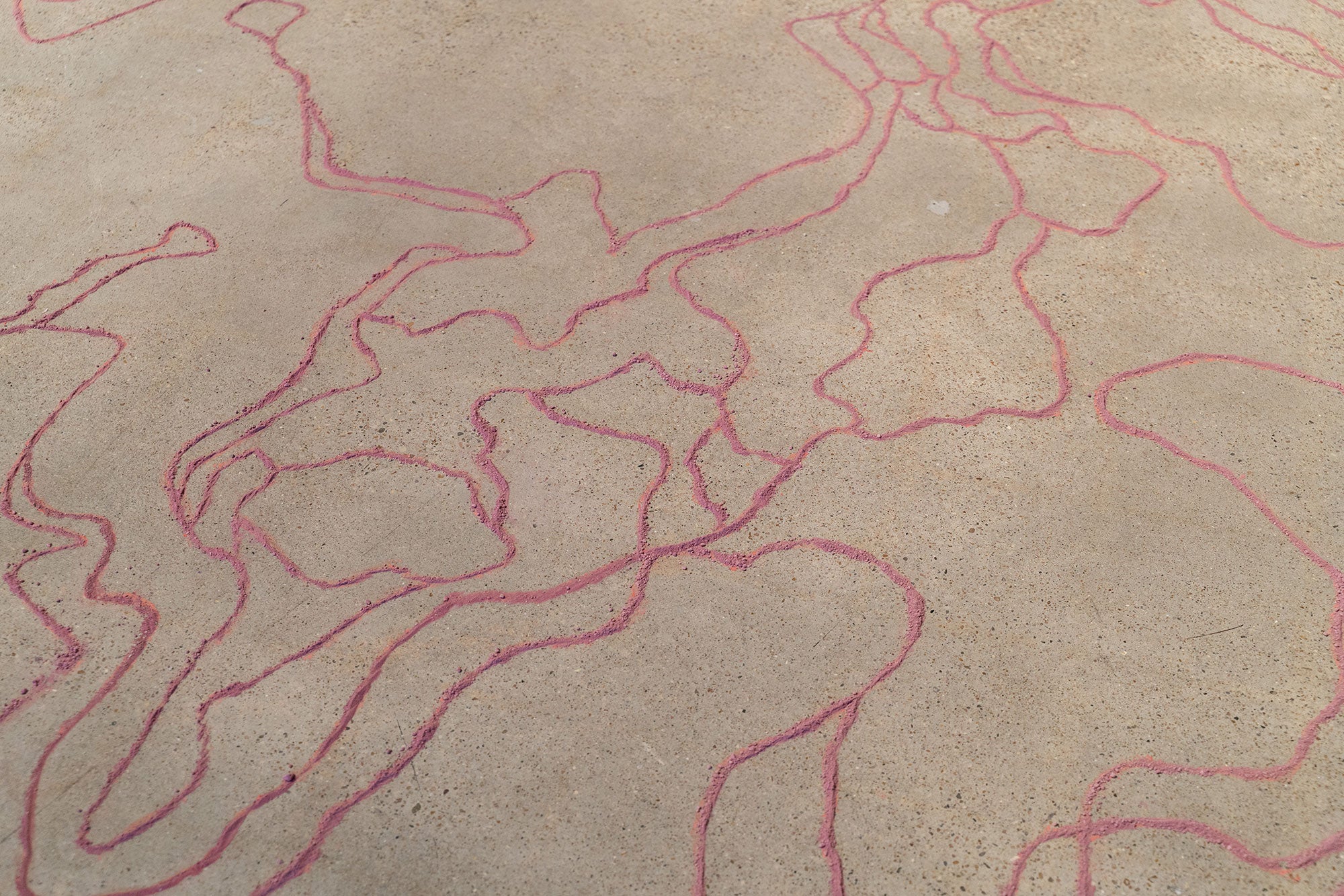
Abby Flanagan, Remote Sensing (detail), 2026. Chalk, limestone sediment, rhodamine dye. Courtesy of the artist.
Opening Reception: Fri. Jan. 23, 5–8 p.m.
The Edwards Aquifer is an underground layer of porous limestone that stores and moves groundwater across Central and South Texas. It supports the industrial, recreational, and spiritual needs of over two million people, yet its scale and hydrogeological inner workings remain largely invisible to those who depend on it. In To Move Through Stone, artist Abby Flanagan uses drawing, sculpture, and installation to trace the aquifer’s systems, study its material form, and represent its critical role in local ecologies.
To engage this hidden system, Flanagan draws upon field research in the Edwards Aquifer’s above and below-ground environments as well as her conversations with its stewards. She transforms collected materials such as limestone, water, mud, plants, and plastic into sculptures injected with rhodamine dye, a fluorescent pink substance used by scientists to trace and measure water flow. A rain gauge extending from the VAC gallery to the outdoor courtyard tracks local weather patterns, connecting the exhibition to the extreme drought and flooding that continue to deplete the aquifer’s water supply.
Across seven new bodies of work, Flanagan repurposes scientific and artistic tools, resisting a complete picture of the aquifer in favor of highlighting its fluid, ever-changing nature and the fragmented ways diverse groups perceive, protect, and give it meaning. Subtle changes in the gallery’s atmosphere further destabilize the works: gravity compresses layered sediment, humidity swells sand, and changing light patterns reveal and conceal details. In To Move Through Stone, Flanagan presents drawing as an expanded form to incorporate the methods, metrics, and emotions used across a range of disciplines to sit with the uncertainty of knowing, representing, and caring for this shared resource, which is increasingly at risk amid the climate crisis and rapid development.
Abby Flanagan: To Move Through Stone is curated by Melissa Fandos, Assistant Curator.
Presenting support for Abby Flanagan: To Move Through Stone is provided by the Texas Commission on the Arts and the Visual Arts Center’s Artist-in-Residency Endowment.


Installation view of Abby Flanagan: To Move Through Stone at the Visual Arts Center, 2026. Photo: Alex Boeschenstein

Installation view of Abby Flanagan: To Move Through Stone at the Visual Arts Center, 2026. Photo: Alex Boeschenstein

Installation view of Abby Flanagan: To Move Through Stone at the Visual Arts Center, 2026. Photo: Alex Boeschenstein

Installation view of Abby Flanagan: To Move Through Stone at the Visual Arts Center, 2026. Photo: Alex Boeschenstein

Installation view of Abby Flanagan: To Move Through Stone at the Visual Arts Center, 2026. Photo: Alex Boeschenstein

Installation view of Abby Flanagan: To Move Through Stone at the Visual Arts Center, 2026. Photo: Alex Boeschenstein

Installation view of Abby Flanagan: To Move Through Stone at the Visual Arts Center, 2026. Photo: Alex Boeschenstein

Installation view of Abby Flanagan: To Move Through Stone at the Visual Arts Center, 2026. Photo: Alex Boeschenstein

Installation view of Abby Flanagan: To Move Through Stone at the Visual Arts Center, 2026. Photo: Alex Boeschenstein
About the Artist
Abby Flanagan is an artist and educator based in Western Massachusetts. Her practice traces interconnections between environment and self, moving across drawing, sculpture, and installation to explore subjects of materiality, presence, and precarity. Flanagan completed a B.F.A. at Montana State University in 2015 followed by an MFA from the University of Texas at Austin in 2022. Her work has shown with galleries, art centers, and artist run projects such as shedshows in Austin (2024), North Loop in Williamstown (2023), NON STNDRD in St. Louis (2023), GrayDUCK in Austin (2023), Tinworks Art in Bozeman (2023), among others. She has participated in artist residencies at SOMA Summer in Veracruz, MX (2021), Orein Arts in Elmira, NY (2019), Burren College of Art Alumni Award Residency in County Clare IR (2016), and Mildred’s Lane in Narrowsburg, NY (2016). She has written for arts publications including Incandescent and served as visual art co-editor for the Bat City Review. She currently teaches Drawing in the Expanded Field at Amherst College.
Special Thanks
Abby Flanagan and Melissa Fandos thank the following people for sharing their knowledge of the landscape:
Zhamilya Abdiken, Studio Assistant
Daniel Alessi, Professor, Department of Earth and Planetary Sciences, Jackson School of Geosciences, The University of Texas at Austin
Bedrock Stone & Design, Lender of the large limestone rock
Lucas Bessire, Professor, Anthropology, Colorado School of Mines
Alex Boeschenstein, Artist
Anahita (Ani) Bradberry, Artist and MASS Gallery Member
Diar Enayatpour
Marcus Gary, Research Associate Professor, Bureau of Economic Geology, Jackson School of Geosciences, The University of Texas at Austin; Lecturer, Department of Earth and Planetary Sciences, Jackson School of Geosciences, The University of Texas at Austin; and Principal Geoscientist, Aquifer Science, Edwards Aquifer Authority
Julia Guernsey, Professor, Art History, The University of Texas at Austin
Maggie Hansen, Assistant Professor, School of Architecture, The University of Texas at Austin, and the graduate students in her Slow Practices seminar: Skylar Brown, Jeanette Chen, Meghan Costello, Camille Freeman, Kristen Juen, Lauren Miraldi, Dominique Lang, Eliana Parkerton, Mattie Purcell, Ameesh Shrivastava, Preya Somani, and Kate Terry
Sophia Hatzikos, Artist
Shay Hlavaty, Communications and Outreach Coordinator, Barton Springs Edwards Aquifer Conservation District
The Meadows Center for Water and the Environment
Emily Lee, Artist and Scholar
Sarah Matthes, Poet
Maggie Mitts
Sydney Nichols
Marina Peterson, Professor, Anthropology, The University of Texas at Austin
Ann Reynolds, Associate Professor, Art History, The University of Texas at Austin
Maria F. Rocha, Indigenous Cultures Institute
Jack Sharp, Dave P. Carlton Centennial Professor Emeritus in Geology, Department of Earth and Planetary Sciences, Jackson School of Geosciences, The University of Texas at Austin
Geary Schindel, President, Karst Works
Haley Singleton, Head of Collections and Operations, Beneski Museum of Natural History, Amherst College
Brian Smith, Principal Hydrogeologist, Caves and Karst, LLC
Peter Sprouse, Underground Texas Grotto
Mai Snow and Gregory Valentine, Artists and Co-Founders of shedshows
University of Texas Libraries
Katherine Vaughn, Artist
Crys Zhao, PhD Student, American Studies, The University of Texas at Austin